Posts

Using the PMC-20 Minicomputer - An example session

This post is a little different. It shows a typical login session on the PMC-20. You start by connecting via a ssh session: Workstation1:~ $ ssh kurt@pmc20 kurt@pmc20's password: Last login: Fri Jan 26 16:24:37 2018 from pi1   #     # ######  #######     #######  #####   #####   ##   ## #     # #           #     # #     # #     #   # # # # #     # #           #     # #             #   #  #  # ######  #####       #     #  #####   #####   #     # #       #     ...

PMC-20 updates

A few notes on my mini computer. I re-wrote MPE (the user shell/commands/accounting system) on and off over the last few months. MPE is now version 3.02. I’ve added a lot of user programs and added features to the utilities I already completed. I’m finishing up a line editor that’s somewhere between ED for the pdp-8 and TECO. All the user utils  (cd, copy, attach, type etc) are multi-user safe and as optimized as I can make them. I found out about the Linux kernel  atime bug that breaks some of my system monitor stuff. Too bad the kernel devs want to keep it broken. Oh, well. I made a file system change that made a 200% speed up to the user experience. Very happy with that. I wrote a couple drivers for low speed and high speed paper tape readers. I wrote a tape drive driver. I can’t find my 500 mb tape drive so I emulated one using sequential files on various media. Really happy with it - I can type “tape save” and save versions of software in seconds. Lots faster ...

Lightwave Communications

Image
It is possible to transmit audio (and data, video etc) across medium to long distances by modulating light with either high power LED's or lasers. Equipment made by others has effective ranges well over 100 miles. The optical portion of the equipment I made is designed for shorter ranges. The electronics portion of the above transmitter will drive any optics. For my optics I use a 3 watt red LED or 20mw red laser driven with a 20KHz pwm signal modulated by one of three sources: a front panel microphone,  line-in (1/8"/3.5mm stereo jack) and an internal linux-based computer (raspberry pi zero version 2). The PWM modulator is a 12F683 PIC based microcontroller from microchip.com. Here is a youtube video showing the system described here: https://youtu.be/ujk117eTPjM The pic microcomputer has 8 pins, and is programmed in assembly. I feed in audio through an audio preamp (2N3904 transistor) which then goes to a op amp and a low pass filter at 4khz. From there it goes int...

Large Format Pinhole Cameras

Image
Building your own camera. Many people built a pinhole camera while in grade school or maybe as late as high school. It's a novelty, and the results reflect that. I built one using the carboard box a pack of 35mm film came in, cut out the end and put a piece of aluminum foil with a hole punched in. It produced an image, if you squinted just right, and the results reflected that. The project was never duplicated. Until last week. There are many forums dedicated to pinhole photography. I never looked into them. However, I was reading some text books I got on Amazon ($0.01 each, $3.99 shipping, brand new 1000 page physics texts) about light and came across a few things. This got me thinking. Seems there are certain ratios, and when followed, give reasonable focus to light when followed. In the camera world, there is a thing known as an f stop, or the amount of light allowed in by a lens.  The f stop is determined by the diameter of the lens and the distance to the film plane...

It's Called the PMC20

Image
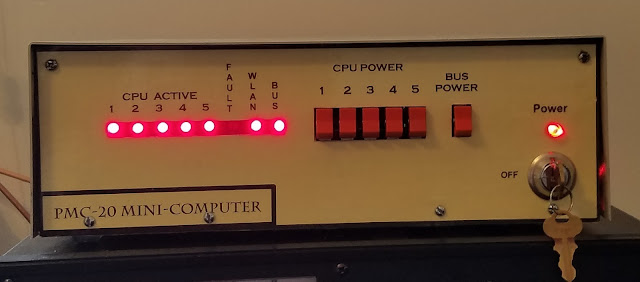
Well, it's coming together. After 9 months of building, rebuilding, and writing a lot of code, I have a working minicomputer. Overview PMC-20 (Personal Mini Computer) is the minicomputer I designed. It is a 5 processor design with 20 CPU cores. It can easily handle 64 simultaneous users running MPE, the operating system I wrote. The operating system is built on the best of the commands I've used from Prime Computer's Primos, DEC's RSTS, unix, GNU Linux, and some that I always thought should be there. The operating system is a set of commands, a custom shell, a specialized directory structure and background processes that ride on top of a Linux kernel. The kernal handles the hardware, MPE does the rest. MPE, or Multi user Programming Environment, is written as a typical 1980's minicomputer/mainframe operating system. It has job control, a multi user accounting package, about 50 built-in commands in the shell which allow the user to create, edit, delete...

RF Testing the computer

Computers of all kinds generate RF energy. This one is no exception. I have the computer sitting on top of some radio equipment. Everything has a ground wire tied to a 20 point buss which goes to the service entrance ground where an 8 foot ground stake is driven in Earth. It's about 40 feet from the equipment. With all the screws tightened on the case, very little noise gets into the receivers (10khz thru 490mhz). In fact with the antennas connected, I really can't hear any interference. I thought there would be more. However, when the amplifier (Ameritron AL-80B) is running in CW mode on 14 mhz, PI1 (primary computer module) gets confused. Not surprising. The computer is sitting on top of the amplifier running 900W out. I put a single ferrite bead on the hdmi cable coming into the computer (the RF output cable is inches from the hdmi cable) and problem solved! I'm really surprised about this. Also what I'm surprised about is the TP-Link router is not affected...

That darned power-off reset

When I set up my mini-computer, I made a few hardware choices due to my familiarity with the Linux operating system. My x86 boxes had uptimes of hundreds of days. With Raspian Jessie, and Raspbian in general, my uptimes are in days. Sometimes not even that. There are A LOT of bugs in Raspbian. So many that I need to change to something completly different, or something a lot older and more stable. My computer has a key switch for main power to the internal 5 VDC supply. The switch turns off/on the AC feeding the supply. I wired each Raspberry Pi to a power buss for the 5v. I didn't add any switches so that I could power up/down the computer modules seperately. And as long as I don't use the computer, it works just fine that way. I use PI1 for development in writing software since running at 1.25 GHz it's the fastest of the 5. But when something goes wrong, I lose connectivity to the rest, and many times it won't even shut down. Just gives me error messages that in...